
Web
of Non-Governmental and
Non-Commercial Organizations
of the Asia and Pacific Region
Involved in Sustainable Energy Development
Profile of
The Center for Energy Efficiency
(CENEf)

| Activities | Contact Info |
| Objectives | Number of Staff |
| Sample Project(s) | Legal Notice |
| Key Persons | Strategic Partners |
Objectives
The Center for Energy Efficiency (CENEf) is a non-profit, independent Russian organization founded in 1992 to promote energy efficiency and environmental protection in The Russian Federation. The main objectives of CENEf are:
-
Develop model legislation and policy proposals to implement energy efficiency measures in The Russian Federation during its transition to a market economy, with an account of economic, environmental, and social impacts;
-
Identify crucial energy efficiency related issues and developing policy papers on these issues;
-
Develop and initiating energy efficiency projects;
-
Identify potential opportunities for economic cooperation, and promote such cooperation between Russian and foreign companies manufacturing energy efficient equipment and/or providing energy efficiency services;
-
Collect and disseminate information on possible energy efficiency measures and programs, Russian and foreign-made energy efficient equipment and technologies, manufacturers of energy efficient equipment, and energy efficiency experts;
-
Prepare and disseminate materials for mass media to promote public education;
-
Conduct energy efficiency training programs for NGOs.
Activities
CENEf works on projects aimed at promoting energy efficiency in The Russian Federation. These include:
-
Drafting energy efficiency legislation in cooperation with federal and independent experts, industries and scientific institutions;
-
Establishing energy efficiency institutions in The Russian Federation's regions;
-
Identifying regulatory incentives for energy efficiency, including new methods to control energy consumption; labels for appliances and equipment; and energy efficiency standards and certificates;
-
Identifying financial incentives for investments in energy efficiency projects in The Russian Federation;
-
Developing financial mechanisms able to adjust to The Russian Federation's rapidly-changing business environment;
-
Identifying and assessing the social, economic and environmental benefits of energy efficiency policies; and
-
Demonstrating successful solutions to economic problems by applying a wide range of energy efficient equipment.
| CENEf audited 13 orphanages and boarding houses in Magadan Region (Russian Far East) and selected three facilities that were in a critical state of disrepair. In these three sites, windows and doors were insulated to reduce infiltration and transmission heat losses. Indoor air temperatures were monitored before and after the project.
Where insulation measures alone could not bring the temperature up to the required level, CENEf also installed infrared ceiling-mounted heaters. The project results may be described as follows:
CENEf recorded this program. The video is now available at CENEf's office for information purposes. CENEf leveraged this initial effort with follow-up activities, which led to installation of meters in 153 additional buildings. |
||
 |
 |
|
|
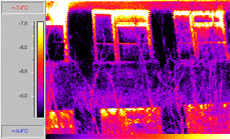
Thermovision survey of windows in the
second floor of the boarding house |
||
|
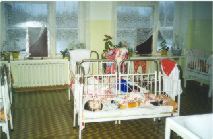
Bedroom for children with serious indigenous
mental and/or physical disabilities  |
||
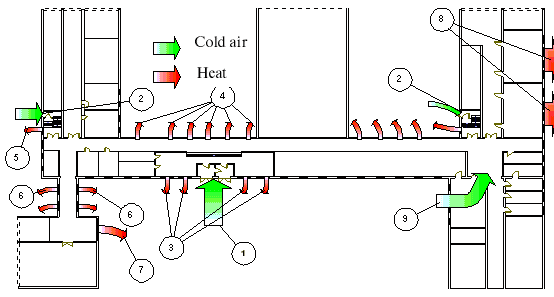 Major heat and air flows on the first floor of the orphanage |
||
Key Person
Igor A. Bashmakov, Executive Director
Contact Info
54, korpus 4, Novocheremushkinskaya St.,
Moscow, 117418, The Russian Federation
Phone/Fax: +7 (095) 120-5147; 913-9526
Fax: +7 (095) 913-9574
http://www.cenef.ru/
E-mail: cenef-mailbox@mtu-net.ru
in the United States:
Meredydd Evans
The Pacific Northwest National Laboratories
Battelle
Phone: (202) 646-7865
Fax: (202) 646-5233
E-mail: m.evans@pnl.gov
Number of Staff
14 persons
Strategic Partners
United Nations Environmental Program (UNEP), the World Bank; Pacific Northwest National Laboratory [United States]; the United States Agency for International Development (USAID); The United States Department of Energy (DOE); the United States of America Environmental Protection Agency (EPA); The Russian Ministry of Energy; Russian Regional Administrations in Orel, Kostroma, Sakhalin, Magadan, Khabarovsk, Tomsk; the European Bank for Reconstruction and Development (EBRD); the International Energy Agency (IEA)/Organization for Economic Cooperation and Development (OECD); the Natural Resources Defense Council [United States]; Alfa Laval [Sweden]; Burns and Roe [United States]; Bacharach, Inc. [United States]; Noviter Oy [Finland]; Danfoss [Denmark]; Honeywell, Inc. [United States]; municipal Russian governments in Kostroma, Lytkarino, Murmansk, Zhukovsky and Yuzhno-Sakhalinsk; Thermax
[India] and others.
Legal Notice
Founded January 1992

Updated 14 March 2001 Webmaster 2001 United Nations. Legal Notice