
Web
of Non-Governmental and
Non-Commercial Organizations
of the Asia and Pacific Region
Involved in Sustainable Energy Development
Profile of the Solar Energy Center - Shiraz University
| Activities | Contact Info |
| Objectives | Number of Staff |
| Sample Project | Key Persons |
| Statistical Data About Iran | Strategic Partners |
Activities
Studies of non-fossil fuel and renewable energy technologies, such as analysis of solar water pumps, comparing theoretical results with experimental measurements.
Objectives
Introduce and demonstrate the feasibility and advantages of non-fossil fuel and renewable energy sources and technologies, particularly solar heating, solar electrification, solar desalination, and solar water pumps for agricultural and drinking water purposes. <return to top>
| Sample Project | ||
|
Performance of a Solar Water Pump in Southern Part of Iran |
||
|
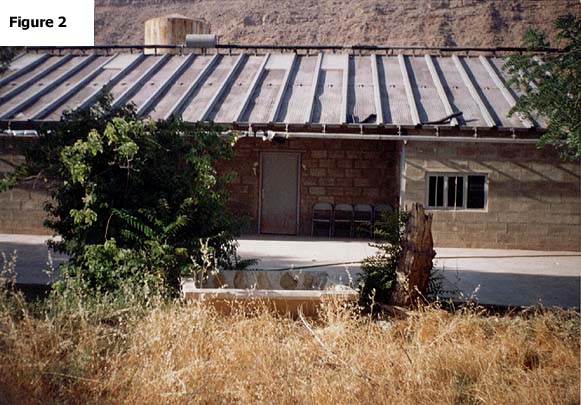
(*Complete report with 11 figures and full references is available in Adobe Acrobat format.) The pump has been installed in Khafr, in the southern part of Iran. The system includes two cycles, the collector cycle and a Rankine cycle. R114 is used as a secondary fluid in a binary cycle engine. Flat plate collectors are employed to pump water by hydraulic transmission. |
||
|
click small images to enlarge |
|
|
||
|
|
|
|
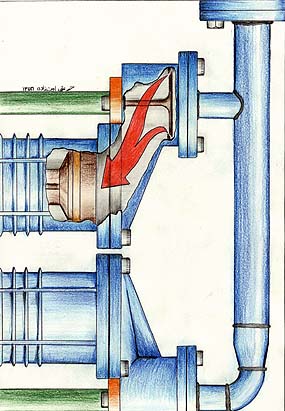
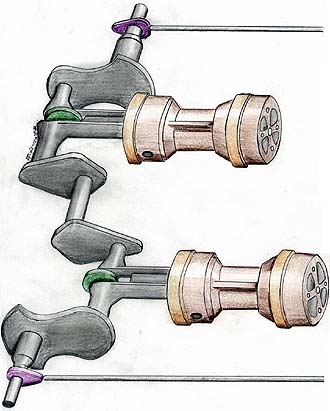
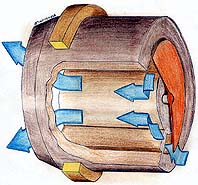
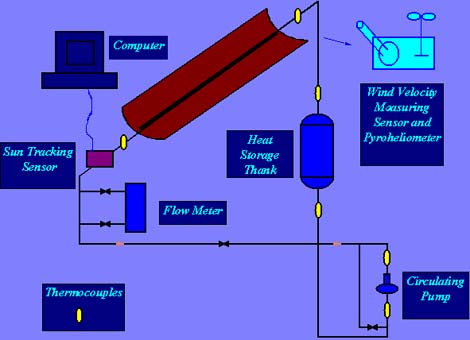
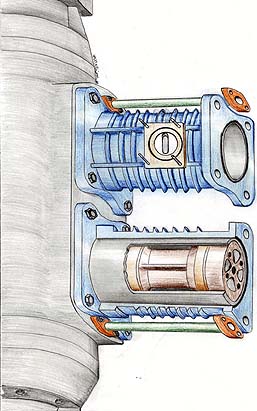
The system works as a binary Rankine vapor cycle. During a working cycle, a manual hand pump pumps water to collectors. The warm water passes from collector to main heat exchanger and then to a preheater. A feed pump from a storage tank in reverse direction to warm water will pump the liquid R114. R114 will be changed to a superheated vapor in order to run the two-cylinder expansion engine. Water with lower temperature returns to the collector while the R114 vapor with low pressure and temperature passes to a condenser.
The freshly pumped water from the well helps the condenser change the R144 vapor to liquid. The water is then stored in a tank 10 meters above ground level. The power output of the engine will push the liquid of R114 to the heat exchanger, the collector circulation water pump and a hydraulic press which help the diaphragm pump to pump water by a reciprocating column of water.
As the sun rises, temperature of the collector also rises until it reaches working temperature. After circulating water in the collector by a manual hand pump for 10 to 15 minutes, the temperature of the absorber plate drops sharply. Since, water absorbs heat from the absorber plate, the water temperature will drop but the temperature profile will be similar. Since the boiler temperature is related to the approach temperature between water and R114, the boiler temperature will change similarly.
Average output of well during a year is 20 m3/day. Average efficiency of system is 2.804%. Average mass flow rate of water of well is 1.285 Kg/s.
<return to top>
-
Area = 1.648 x 10¹² m2 = 1.648 x 10⁶ Km2
-
Population = 65 x 106
-
Population density = 40 persons/Km2
-
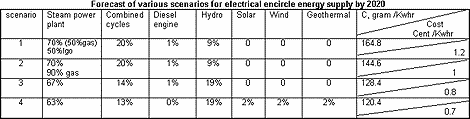
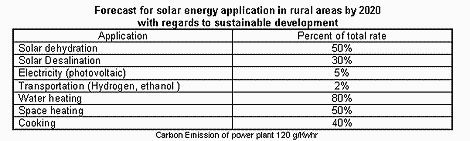
Carbon emission of power plants 169 g/Kwhr
-
Solar radiation energy on a horizontal surface = 19 MJ/m2
-
Total solar radiation/year = 1016 MJ = 4,000 energy consumption/year
-
Number of villages in rural areas = 65,349
-
Number of rural villages with electricity supply (more than) 45,000
-
Population growth in rural areas = (absolute)1.99%
-
Population growth relative urban area =1.25%
-
Number of rural households = 2.5 million
-
Population forecast for 2020 = 100 x 106 (urban area = 60%, rural area = 40%)
-
Carbon emission by power plants = 120 g/Kwhr.
-
Electrical energy encrease/year in rural areas = 5 MKWh
-
With present rate of electricity supply all villages will have electricity by 2012
-
Most villages without electricity are in the southern part of Iran
<return to top>
Information About Rural Areas in Southern Part of Iran
-
Far from electric grid network
-
Dispersed villages with population of less than 20 households
-
Low rainfall, less than 200 mm/year (water is scarce)
-
Remote from main city centers
-
High emigration rate, less developed than other areas
-
Far from fuel pipelines and fuel gas distribution
-
High solar potential
-
Close to Persian Gulf and Sea of Oman
-
Clean area with tremendous amount of minerals and other sources
-
High potential for agricultural industries (land, solar radiation)
<return to top>
Barriers to Renewable Energy Utilization in Iran
-
Very low cheap of fossil fuel, gas oil = $0.05/liter, fuel gas less than $0.01/m
-
Society lacks of awareness from renewable energy practices (specially people in the urban and rural areas)
-
Low educational level of people in the area
-
Very high initial cost
-
Unavailable technological development
-
No cultural acceptance of renewable energy technologies <return to top>

Key Persons
M. Aghamohammadi
M. Yaghoubi
J. Zarinchang
Contact Info
Shiraz University, Shiraz, Iran
Email: yaghoub@succ.shirazu.ac.ir
Number of Staff
3 persons
Strategic Partners
SOFRETES Company

Updated 14 March 2001 Webmaster 2001 United Nations. Legal Notice